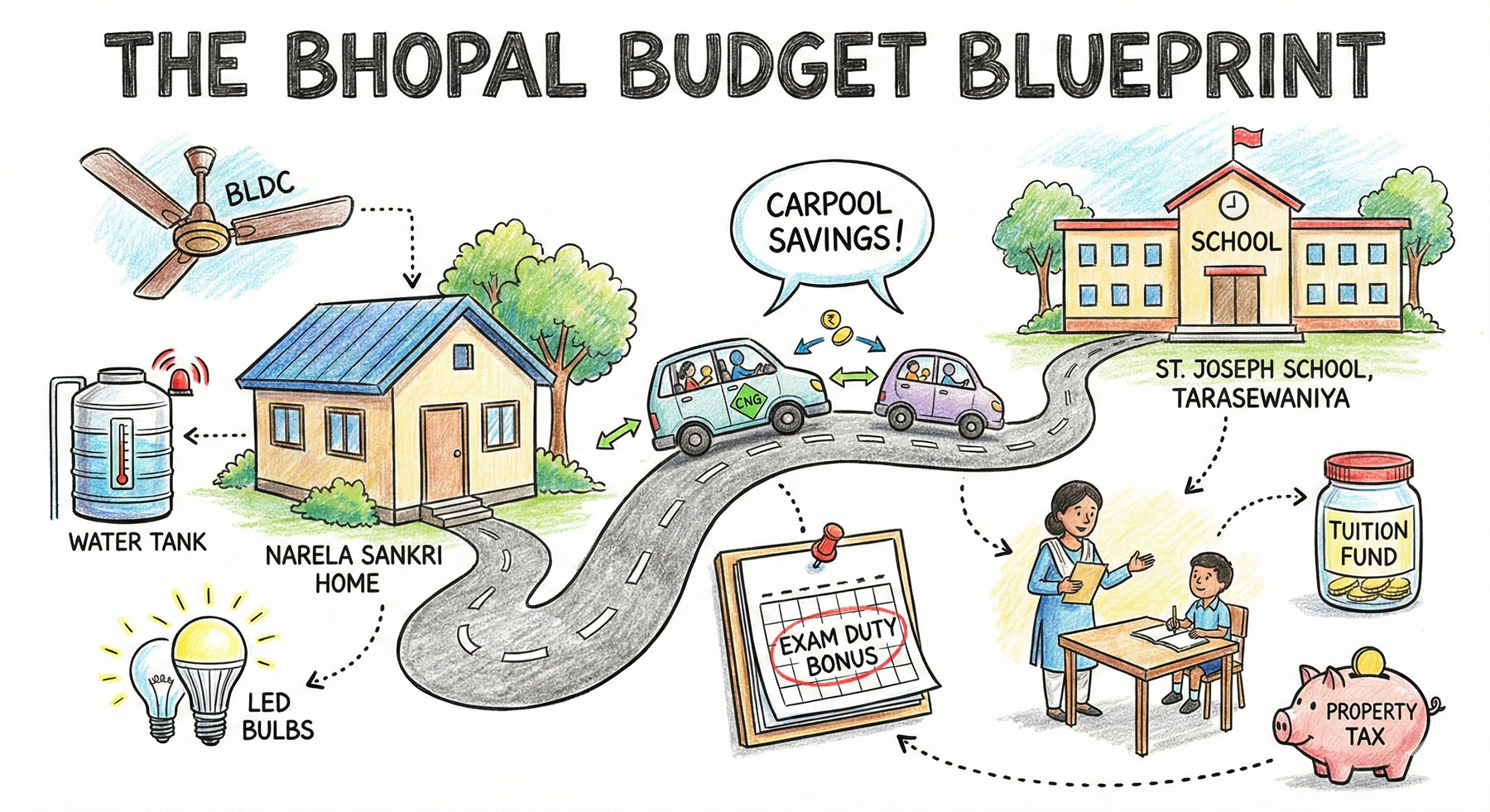
The “Geography Tax” Survival Guide: Why Two Teachers in Bhopal Spend ₹24,000 a Month on Cars

Published on: Tigris Zion Media

Category: Real Life / Personal Finance

Author: A Teacher from Narela Sankri

Reading Time: 9 Minutes


Meta Description: Two teachers, ₹55k income, and a 54km daily commute from Narela Sankri to Tarasewaniya. Here is the exact math of how we survive ₹24k car EMIs using CNG, BLDC tech, and the “Carpool Economy.”


Introduction: The 27-Kilometer Reality Check

It is 6:45 AM in Narela Sankri. My car engine hums to life, not on petrol, but on the quieter, cheaper hiss of CNG. I have a long road ahead—literally.

My workplace, St. Joseph International School, is in Tarasewaniya. That is exactly 27 kilometers one way. A 54-kilometer round trip, six days a week.

My partner is also a teacher, but her school is closer—just 7 kilometers away.

Together, we bring home ₹55,000.

Together, we pay ₹24,000 in car EMIs.

If you do the math, nearly 44% of our combined salary vanishes the moment it hits the bank, just to pay for the machines that take us to work. It sounds insane. In any other city, we would take a Metro or a bus. But have you ever tried getting from Narela Sankri to Tarasewaniya on public transport in time for the morning assembly? It’s not a commute; it’s an expedition.

We are living a life that looks comfortable from the outside—two cars, a parental home, respectable jobs—but inside, it is a constant game of financial Tetris. Here is how we play to win.


Chapter 1: The CNG Strategy & The “Paid” Passengers

The biggest bleeding point in our budget was the 54km daily run to St. Joseph. On petrol, this would bankrupt us.

The CNG Savior:

I strategically bought a CNG car for this long haul.

  • Petrol Cost (Est): ₹10/km × 54km = ₹540/day.
  • CNG Cost (Real): ₹4/km × 54km = ₹216/day.
  • That switch alone saves us roughly ₹8,000 a month.

The “Colleague Subsidy”:

But even ₹216 a day adds up. This is where I had to swallow my pride. I realized two other colleagues travel from my side of town to Tarasewaniya.

I didn’t offer a free ride. I offered a service.

“I drive, you relax. AC on, dust off.”

They agreed to pay ₹1,800 each per month.

The Math of Survival:

  • Fuel Cost: ~₹6,000 (CNG)
  • Incoming Cash: ₹1,800 × 2 = ₹3,600
  • Net Cost to Me: ₹2,400.

By monetizing my empty seats, I turned a crippling expense into a manageable one. My partner drives the second car for her 7km commute. It’s a luxury, yes, but in the Bhopal heat and monsoon, arriving at school looking like a drowned rat isn’t an option for a teacher.


Chapter 2: The “Smart” Home in Narela Sankri

We live in my parents’ home in Narela Sankri. The house is intact, so we pay zero rent. But “rent-free” doesn’t mean “cost-free.”

The Hidden Tax:

We have a Property Tax of ₹5,000 per year. It hits us once a year, usually when we least expect it. We have to save roughly ₹420 a month just for this.

The Electricity War:

Our electricity bill used to be a shocker. We realized that with two cars eating our salary, we couldn’t afford high utility bills. We declared war on watts.

  1. The BLDC Revolution: We replaced our old, noisy fans with BLDC (Brushless Direct Current) fans. They consume 28 watts instead of 75 watts.
  2. The Water Tank Hack: We realized we were wasting electricity (and water) by letting the overhead tank overflow every morning. We installed a simple Water Level Indicator with an alarm. Now, the motor runs for exactly the minutes needed, not a second more.
  3. The LED Switch: Every yellow bulb was thrown out. Now, every corner of the house glows with 9-watt LEDs.

These aren’t “gadgets”; they are our financial defense system. They keep our bill under ₹1,500, even in summer.


Chapter 3: The “One Student” & The Exam Duty Bonus

We are teachers. The world thinks we make money from tuitions. The reality?

I have one student.

Just one. A neighborhood kid who pays ₹1,000 per month.

It feels almost laughable. ₹1,000? What does that buy?

But in our house, that ₹1,000 is the designated “Internet Money.” It pays for our WiFi and part of our mobile data. If that student quits, we lose our connection to the world. It makes you realize how fragile the system is.

The “Jackpot” Month:

Then there is the Board Exam season. Once a year, we get Exam Duty. It’s grueling work—standing for hours, invigilating.

But it brings in a check of about ₹7,000 annually.

We don’t spend this. This ₹7,000 + our saved coins go straight to the Property Tax (₹5,000) and the car insurance renewal. It is our “bailout package.”


Chapter 4: The Pause

Sometimes, on the drive back from Tarasewaniya, when the traffic at the bypass is gridlocked, I pause and wonder.

We earn ₹55,000. We are educated. We are teachers molding the next generation at prestigious schools like St. Joseph. Yet, we are counting every kilowatt of electricity. We are calculating CNG mileage to the second decimal point. We are depending on two colleagues paying ₹1,800 to balance our fuel budget.

Why?

Because we refuse to compromise on two things: Our Mobility and Our Home.

We could sell the cars and save ₹24,000. But then we would lose 3 hours a day waiting for buses.

We could move closer to the school and pay rent. But then we lose the safety of our Narela Sankri home.

So we choose this struggle. We choose the BLDC fans and the CNG kits. We choose the carpool awkwardness.

The Final Ledger

CategoryThe CostThe Strategy
Car EMIs₹24,000Non-negotiable (for now)
Fuel (54km Commute)₹6,000Reduced to ₹2,400 (thanks to ₹3,600 from colleagues)
Rent₹0₹420/month saved for Property Tax
Electricity₹1,500Capped via BLDC Fans & Water Alarms
WiFi/Data₹1,000Paid by The One Student (Tuition)
Exam Duty Bonus+₹7,000/yrFunds the Property Tax & Insurance

The Takeaway:

If you see my car passing by on the bypass, don’t envy the vehicle. Respect the logistics. We aren’t just driving; we are managing a complex equation of time, distance, and money.

And for now, the math is working. Just barely. But it’s working.

More From Author

ICSE Class 10 Examination Timetable 2026 Released: Full Schedule, Dates & Time

The Council for the Indian School Certificate Examinations (CISCE) has officially released the timetable for…

📱 Top 2 Compact Smartphones of 2025 – OnePlus 13s vs Vivo X200 FE (Specs & Buying Guide)

In a world of oversized phones, compact powerhouses are making a comeback. If you’re looking…

Capturing the Beauty of Nature\’s Blossoms

In today\\\’s fast-paced world, managing your monthly budget effectively is essential for financial stability and…

Leave a Reply

Your email address will not be published. Required fields are marked *